
Colorectal and Digestive Health Screening
Many colorectal and digestive conditions start developing unnoticed. Fortunately, screenings like a colorectal cancer screening can detect them early, while they’re at their most treatable.
When performed by experts, screenings are safe and straightforward procedures. Our professional team can provide a variety of digestive health screenings at our two locations.
Who Should Get Colorectal Screenings
People 50 years old and above are advised to get colorectal screening regularly, even if they do not have any risk factors for colorectal cancer. Individuals with increased risk should start earlier.
The recommended frequencies for screenings are as follows:
- People with no risk factors
- Traits: Asymptomatic, no immediate family history of colorectal cancer
- When to start tests: Age 50
- Test frequency: Every 5 to 10 years
- People with high risk factors
- Traits: Colorectal cancer in first-degree relatives, personal history of colorectal malignancy or ovarian/endometrial cancer
- When to start tests: Start at age 40 or 1 year after detection of a high-risk polyp
- Test frequency: Get tested every 5 to 10 years, but if you have a personal history of colorectal polyps, get tested every 1 to 3 years
- People with very high risk
- Traits: Family history of colorectal cancer or familial adenomatous polyposis, inflammatory bowel disease
- When to start tests: Usually from ages 20-25, or around 10 years younger than the age at which the youngest affected family member was diagnosed
- Test frequency: Get tested every 1 to 2 years, or as advised by your specialist
Why Get Colorectal and Digestive Screening Regularly
- Prevention: A chance to remove precancerous polyps before they become cancerous.
- Early detection: Identification of colorectal cancer in its earliest, most treatable stages.
- Improved prognosis: Early diagnosis and treatment significantly increase survival rates and recovery chances.
- Peace of mind: Regular screening allows you a measure of certainty over the state of your own health instead of wondering about it.
Not Sure if You Need a Screening?
Book an appointment for proper medical assessment or diagnosis by a colorectal surgeon, especially if you have recurring abscesses or persistent discharge.
Colonoscopy
What Is a Colonoscopy and What Does It Detect
A colonoscopy is a diagnostic procedure used to detect abnormalities in the colon. Examples of abnormalities are polyps, colorectal cancer, ulcers, inflammation (colitis), diverticula, and bleeding sources.
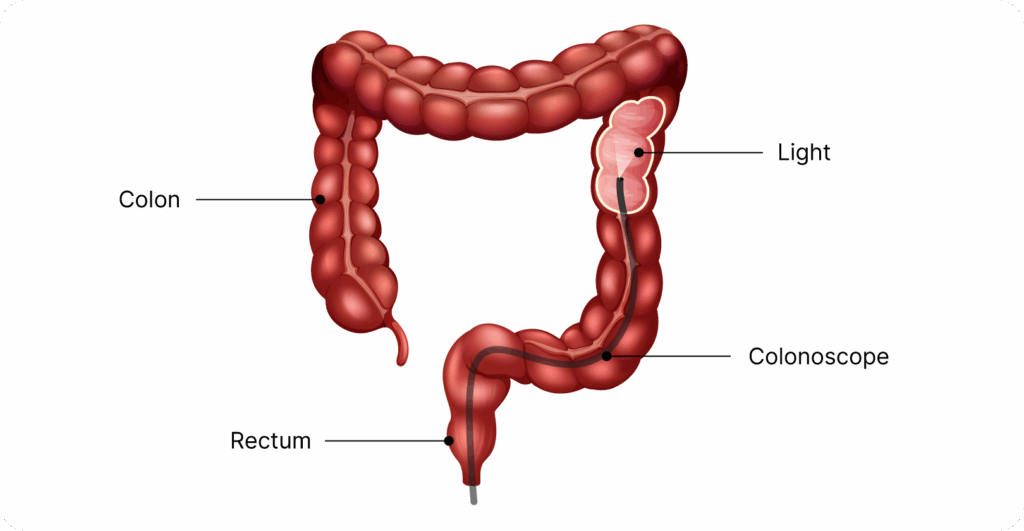
The procedure allows direct visualisation of the large intestine through insertion of a flexible tube with a tiny camera into the colon via the rectum. It can also be used to take biopsies or tissue samples for analysis. It also allows the removal of polyps for early detection or prevention of colorectal cancer.
What to Expect with Colonoscopy
Before the Screening
Our doctor and team will explain the process of screening to you and describe any preparatory steps you need to take.
For example, you may be advised to do bowel cleaning with prescription laxatives before the procedure, to empty your colon. You are also typically advised to avoid high-fibre food the day before the colonoscopy and stick to a liquid-only diet.
During the Screening
During the screening, you will usually be sedated to minimise discomfort. The procedure may take anywhere from 30 to 60 minutes.
You will be asked to lie on your side to allow insertion of the colonoscope into your rectum. The doctor will then manoeuvre it to inspect the inside of your colon or possibly remove polyps or tissue for biopsies.
After the Screening
After the colonoscope is removed, you are monitored until the sedative wears off. No stay in the hospital is needed, although you may need help going home due to the after-effects of sedation.
Colonoscopy Risks and Recovery
Colonoscopy is generally low-risk. However, like every procedure, it can have some side effects or risks:
- Mild bleeding, especially if polyps are removed
- Some temporary discomfort or bloating
- In rare cases, bleeding or perforation
Most people find that they can return to daily activities the very next day.
Who Should Get a Colonoscopy
The colonoscopy is a routine screening recommended for adults aged 50 and above (to detect colon cancer), even if they have no symptoms or risk factors.
Those with risk factors may have to get it more frequently to better monitor their health. Individuals with abnormal symptoms like rectal bleeding, persistent abdominal pain, or unexplained weight loss may consider it too.
Gastroscopy
What Is a Gastroscopy and What Does It Detect
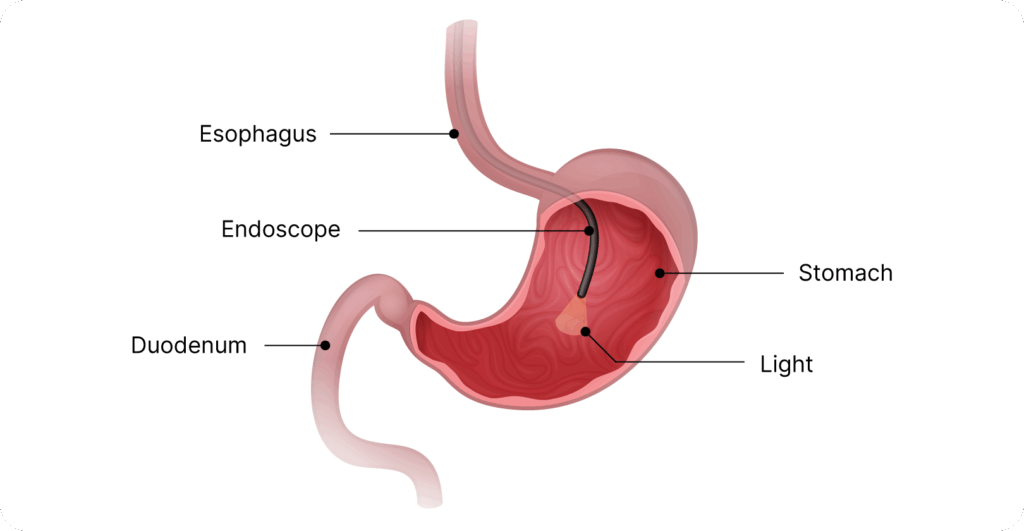
The gastroscopy is a diagnostic procedure that helps identify the causes of upper abdominal pain, persistent reflux, ulcers, gastritis, bleeding and some cancers. It requires insertion of a flexible tube with a tiny camera through your mouth.
This camera gives doctors direct visualisation of the oesophagus, stomach and upper small intestine. It can also be used to take biopsies for infections or assess abnormal tissues. This can help prevent gastric cancer or detect it early, as it may only show through subtle changes in the gastric lining that are difficult to notice otherwise.
What to Expect from Gastroscopy
Before the Procedure
You will usually be asked to fast for 6 to 8 hours before the procedure. This ensures an empty stomach for clearer visualisation.
During the Procedure
During the gastroscopy, you will be under either mild sedation or a local anaesthetic spray to minimise discomfort in your throat. The procedure typically takes 10 to 20 minutes.
The doctor will guide the tube with the camera into your mouth and down your throat for a visual inspection of your stomach. Fine instruments may also be passed through it for the removal of tissue for biopsies or polyps.
After the Procedure
After the procedure is done and the tube has been removed, you will be monitored until the sedative effects wear off. This does not necessitate a hospital stay after, although you may need help getting home due to the after-effects of sedation.
Risks and Recovery for Gastroscopy
While gastroscopy is largely considered safe, it may have some minor risks or side effects, like other procedures:
- Bloating
- Sore throat
- In rare cases, bleeding or perforation
Recovery from the procedure is swift, and patients should be able to head home the same day.
Who Should Get a Gastroscopy
A gastroscopy is often recommended for individuals with ongoing symptoms related to the stomach, oesophagus, throat, or duodenum. It may be considered in cases of persistent heartburn or reflux, unexplained nausea or vomiting, difficulty swallowing, upper abdominal pain, or suspected gastrointestinal bleeding.
Symptoms like these may merit the procedure:
- Difficulty swallowing
- Heartburn or acid reflux symptoms non-responsive to medication
- Persistent and unexplained nausea or vomiting
- Upper abdominal pain
Other Diagnostic Scans and Tests
We have a variety of other colorectal screenings available at Aelius Surgical Centre.
Fecal Occult Blood Test (FOBT) / Fecal Immunochemical Test (FIT)
This is a non-invasive stool test that searches for hidden blood in your stools. It can be used for colorectal cancer screening, as blood in the stool may be a symptom of the condition.
CT Colonography (Virtual Colonoscopy)
This is a technique used to visualise the colon and rectal wall with radiology. Again used mainly for polyp detection in the colon, it requires bowel cleansing like a traditional colonoscopy but uses a CT scan for minimally invasive imaging
Barium Enema
This uses a lubricated tube to put barium sulfate in the colon, after which X-ray images are taken of the area. The barium provides contrast to better show abnormalities and shapes in the X-ray images.
Capsule Endoscopy
The patient swallows a capsule with a camera, light source, and transmitter. The camera takes photos as it travels through the digestive tract and these are transmitted wirelessly to a sensor for evaluation. It can help identify issues like Crohn’s or tumours.
Anorectal Manometry / Defecography
A thin catheter or tube with a pressure-sensitive sensor is inserted into the rectum to measure the pressure exerted by the anal sphincter muscles. It can identify the causes of bowel issues like incontinence or constipation.
Colorectal Screening Fees and Insurance Coverage
For a detailed fee breakdown or to check your eligibility for insurance or Medisave claims, please get in touch with us.
Book a Colorectal Screening Now
If you believe you have colorectal issues or symptoms of them, book an appointment with our specialist today for a screening and medical assessment.