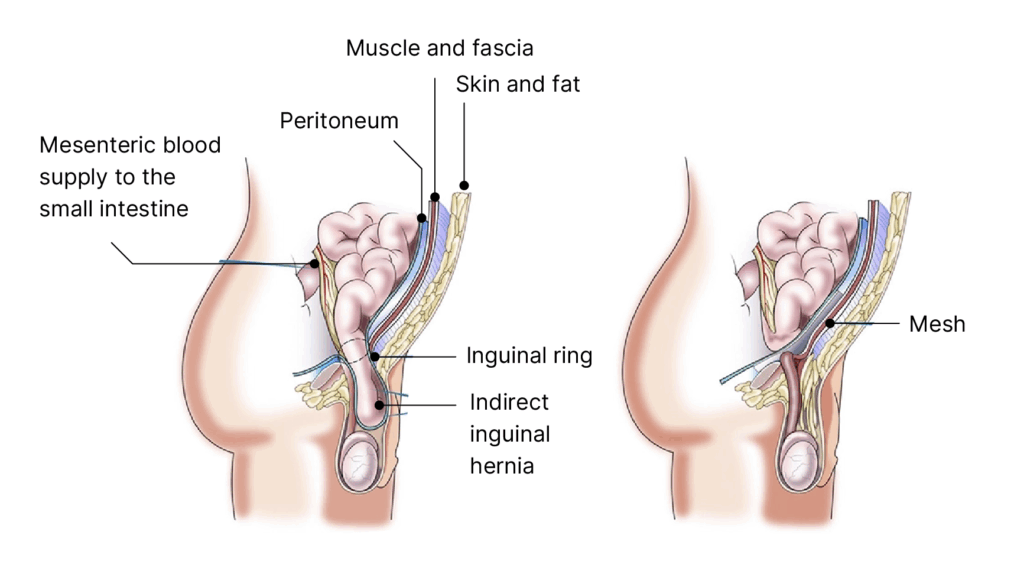
Before the Surgery
During the pre-operation consultation, our doctor will examine you to confirm the diagnosis and explain the recommended treatment. This will include explanations of the procedure, goals, risks, and prep and aftercare instructions.
At this stage, we encourage patients to ask questions or raise their concerns – our doctor will answer all of your queries and provide whatever information he can supply for your case. Our team will also run through all of the pre-surgery and post-surgery instructions with you.
During the Surgery
Depending on the complexity of your case, a groin hernia repair typically takes around an hour and is often an outpatient surgery. It may also be performed under general or local anaesthesia, depending on your circumstances.
These are the main steps:
- Creating the incision
- Pushing back the herniated tissue into its proper place
- Repair of the weak spot where herniated tissue “poked” out”
- Placement of a mesh patch over the weak spot
- Securing the mesh patch to the surrounding muscles
- Closure, stitching, or stapling of the incision
- Application of dressings to protect the surgical area as it heals
After the Surgery
Lower groin hernia repair is typically performed as a day procedure, allowing most patients to be discharged the same day. Your doctor will advise you on post-operative care, with follow-up scheduled to monitor your recovery.
If you experience any of the following, however, you should reach out to your doctor immediately.
- Abnormally fast heart rate
- Blood seeping through your bandage
- Chills
- Fever
- High blood pressure
- Pain, redness, warmth or swelling at the incision
- Pain in your leg (including your calf, behind your knee and thigh) or groin
- Pus draining from the incision
- Shortness of breath
- Sudden swelling, warmth or redness in your leg or groin
- Warm or clammy/sweaty skin
Recovery and Prognosis for Groin Hernia Mesh Repair
Since this procedure is generally outpatient, patients can generally go home on the same day for recovery. You can typically return to light activities within 1 to 2 weeks, but full recovery and heavy activities may require up to 6 weeks of healing first.
Patients can usually shower after a few days if using a waterproof dressing. Otherwise, it is recommended that patients wait around 2 weeks for the wound to heal first.
As for the prognosis, groin hernia mesh repair is considered durable. About 80-90% of patients remain hernia-free after it, including those who receive inguinal hernia repair with mesh.
Risks and Side Effects of Groin Hernia Mesh Repair
While groin hernia mesh repair is a common procedure for hernia treatment, it has its risks and possible side effects, like all other surgeries:
- Bleeding or fluid collection (seroma/hematoma)
- Bruising in the area
- Chronic groin pain
- Infection after surgery, the risk of which can be brought down with antibiotics
- Temporary difficulty urinating
- Pain in the testicles
- In rare cases, recurrence of the hernia despite surgery
- In rare cases, early breakdown or erosion of synthetic mesh
- In rare cases, testicular complications, which only occurs in 0.3% to 7.2% of patients