Before the Surgery
Your pre-operation consultation will involve your doctor diagnosing your condition and explaining the recommended treatment. The procedure, goals, and risks will be explained, as well as pre-procedure rules you’ll need to follow.
At this stage, our colorectal specialist will also offer detail on your condition and treatment. You can ask questions or raise concerns with us at this time, and we will do our best to address each one.
During the Surgery
Depending on the exact procedure or complexity of your case, haemorrhoid laser treatments are typically day surgeries that take only 20 to 30 minutes. Your circumstances will also determine if general or local anaesthesia should be used.
The main procedure is as follows:
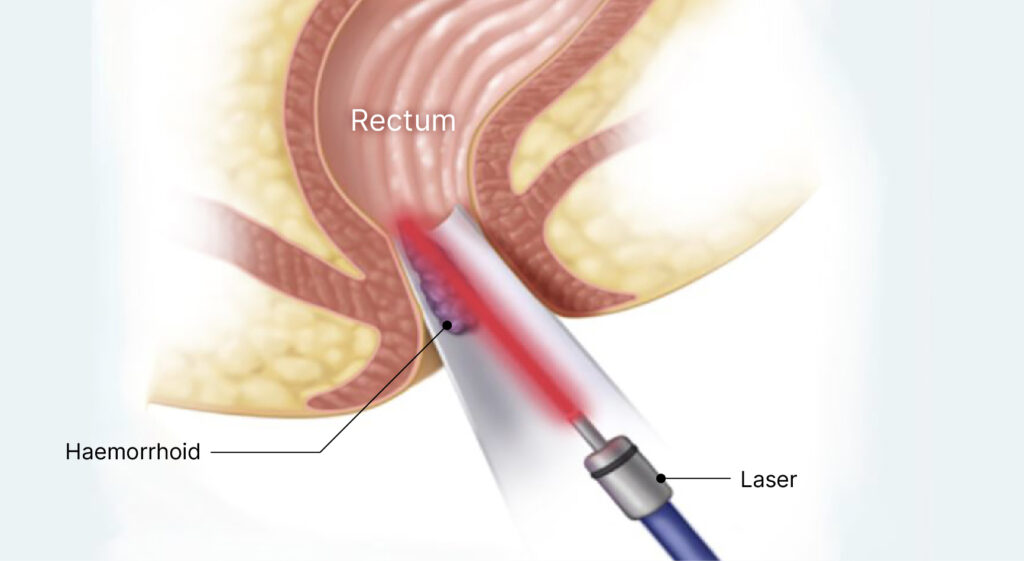
- The surgeon uses an anoscope to find each enlarged haemorrhoid.
- The surgeon may use a stitch (mucopexy) if the piles are prolapsed.
- A small laser fibre or probe is inserted to deliver laser energy to the target area.
After the Surgery
Most patients can leave the hospital on the same day they get the surgery. Only more complex cases require a short hospital stay, often just for 1 to 2 days.
Recovery typically takes 1 to 2 weeks of downtime, after which most people can resume light activities. Strenuous activities are usually only advised after 4 to 6 weeks, after which most patients are fully recovered.
Your doctor will give you post-operative instructions for wound care to help you along. Sitz baths may also be advised, and post-operative follow-ups are typically scheduled.
While recovering, it is advised to look out for these symptoms and contact your doctor immediately if you experience any of them:
- Bleeding so heavy that it seeps through your bandage
- Difficulty urinating or passing stool
- Dizziness
- Fever or vomiting
- Severe pain in the area
Recovery or Prognosis for Haemorrhoid Laser Treatment
Because the procedure is generally outpatient, you can typically go home on the same day for recovery. For best results, it is advised to follow your doctor’s post-operation notes, which may include these:
- You may walk around and do light activities immediately after the procedure, but prioritise rest for the first 1-2 days.
- Avoid heavy lifting or vigorous exercise for about 4-6 weeks.
- You may shower normally, but keep the area dry & clean, avoid rubbing, and change any dressings or pads as instructed.
- Take sitz baths for 10 to 15 minutes, 2-3 times a day and/or after bowel movements.
- Eat a high-fibre diet, drink plenty of water, and use your prescribed stool softeners.
- Try not to strain on the toilet during bowel movements.
The prognosis for haemorrhoid laser treatment varies by case. However, the vast majority of patients achieve full or near-full resolution of symptoms within a few months of the procedure.
It is advised that patients continue a high-fibre diet, sustain healthy exercise, and avoid straining to minimise recurrence.
Risks and Side Effects of Haemorrhoid Laser Treatment
While haemorrhoid surgery and treatment is a minimally invasive procedure, there are certain risks for it, as with all other procedures:
- Infection after surgery, the risk of which can be brought down with antibiotics
- Short-term side effects like pain, light bleeding, or spasms
- Recurrence of the haemorrhoids following surgery, as new haemorrhoids can develop in the area over time
- In rare cases, anal incontinence or stenosis